
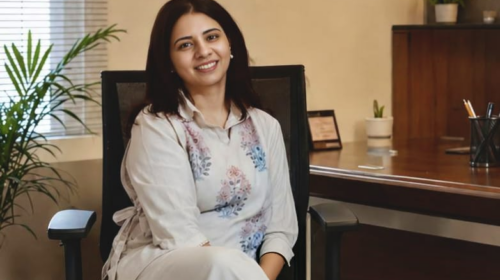
At BrilliantRead Media, we always strive to bring meaningful and inspiring stories from India and around the world to empower and motivate our growing community. As part of this endeavour, we invited Aashima Galhotra for an exclusive interview with us.
A Chartered Accountant with over 18 years of professional experience, Aashima Galhotra has built a multifaceted career spanning finance, education, entrepreneurship, coaching, professional training and business advisory. Her professional journey includes experience with organisations such as Iffco Tokio General Insurance and Aircel Ltd., followed by establishing and continuing her Chartered Accountancy practice.
However, her journey into communication and coaching began much earlier than her professional career.
From the age of 14, Aashima was actively involved in public speaking, debates, elocution and stage competitions. She was frequently selected by her school to represent it in competitions and went on to win several prizes, including at the national level. While Chartered Accountancy became her chosen profession, public speaking remained a natural strength and a passion that continued to stay with her.
Over time, her professional experiences helped her recognise something important: qualifications and technical competence may open doors, but communication, confidence and the ability to connect with people often determine what happens after the door opens.
Her association with the Institute of Chartered Accountants of India (ICAI) as a visiting faculty member brought these two sides of her personality together. While training and mentoring more than 50,000 students and professionals, she repeatedly encountered talented and knowledgeable individuals who struggled to communicate their abilities with confidence.
That observation eventually led her to formally expand her expertise into mindset and communication coaching, executive presence, leadership development, NLP, emotional intelligence, life and business coaching and professional training.
Today, Aashima works with students, professionals, entrepreneurs, founders, corporates and educational institutions, helping individuals recognise their strengths, challenge limiting beliefs, communicate with confidence and develop stronger executive and leadership presence.
She is also the founder of Jan Pehchaan, a platform inspired by the belief that self-recognition is the starting point of meaningful personal growth.
Alongside her coaching and training work, Aashima continues to practise as a Chartered Accountant and is a partner in a large CA firm with 15+ partners, including a branch in the UAE. The firm provides services across audit, accounting, taxation, compliance, due diligence and financial advisory, covering both Indian and international requirements. Let’s learn more about her journey, philosophy and insights.
Excerpts from our exclusive interview with Aashima:
You have built an 18+ year career across finance, education, entrepreneurship, coaching and training. How did this journey actually unfold?
When I look back at my journey, it may appear that I have moved through several completely different professions. But for me, there has always been a connecting thread, and that is people, communication and potential.
My connection with communication actually started much before my professional career.
I was around 14 when I started participating actively in public speaking, debates, elocution and stage competitions. I loved being on stage, and I was frequently selected by my school to represent it in competitions because I was confident speaking and communicating.
I won several competitions, including competitions at the national level.
At that age, I didn’t think of public speaking as a career. It was simply something I loved doing.
Then, like many students, I followed an academic and professional path. I became a Chartered Accountant and started my corporate career with organisations such as Iffco Tokio General Insurance and Aircel Ltd. Eventually, I established my own CA practice.
That phase gave me a strong foundation in finance, business, analysis, discipline and professional decision-making.
But communication remained a part of me.
As I progressed professionally, I began asking myself a very simple question:
“How did I get the opportunities that came my way?”
Of course, my CA qualification, technical knowledge and hard work played a very important role. But I realised there were many equally qualified professionals.
What differentiated me in many situations was my ability to communicate, connect with people, express myself confidently and make people comfortable interacting with me.
That realisation became important.
Then came my association with ICAI as a visiting faculty member.
Teaching gave me the opportunity to combine my technical knowledge with my natural ability to communicate.
And while working with students and professionals, I noticed something repeatedly.
There were people who knew their subjects extremely well, but they struggled to express what they knew.
They had knowledge but lacked confidence.
They had ideas but hesitated to speak.
They were technically competent but were not always able to communicate their value.
That made me realise that there was a significant gap between knowing something and being able to communicate it effectively.
And that became the bridge between my earlier passion for communication and the coaching work I do today.
So I don’t see my journey as a sudden shift from Chartered Accountancy to coaching.
The interest in communication was always there. My professional journey simply helped me understand its importance, and my experience with thousands of people showed me how much of a difference it can make.
You were already a strong public speaker from a young age. Why didn’t you pursue communication as a career initially?
At that stage, I didn’t really think of public speaking as a career.
It was something I was naturally good at and genuinely enjoyed.
When you are 14 or 15, you participate in competitions because you love the experience, the stage and the excitement of representing your school.
I never thought, “One day I will become a communication coach.”
My academic interests and professional aspirations took me towards Chartered Accountancy, and I pursued that path seriously.
But I think some strengths stay with you even when your career takes you somewhere else.
Public speaking continued to help me throughout my professional life.
Whether it was interacting with clients, presenting an idea, teaching, building relationships or handling professional conversations, I was comfortable expressing myself.
It was only much later, when I reflected on my career, that I realised this wasn’t simply a personality trait.
It was a professional strength.
And sometimes, the things we naturally enjoy early in life become the strengths that differentiate us much later.
At what point did you realise that communication and confidence were contributing significantly to your professional success?
It happened gradually rather than through one particular incident.
As my career progressed, I started noticing that opportunities often came through people.
A client had to trust you.
A senior had to believe in you.
A team had to understand your thinking.
A student had to connect with what you were teaching.
A professional relationship had to be built.
And in all of these situations, technical knowledge was important but it was not enough.
I began to understand that your qualification may tell people what you have studied, but your communication often tells them what you can do with that knowledge.
That was a powerful realisation for me.
I also noticed that people who were not necessarily the most technically knowledgeable sometimes progressed faster because they were more comfortable expressing themselves, building relationships, presenting their ideas and taking ownership.
This doesn’t mean communication is more important than competence.
Quite the opposite.
Communication allows competence to be recognised.
You can have exceptional expertise, but if you cannot communicate your thinking, people may never fully experience the value you bring.
That understanding eventually became central to my coaching philosophy.
How did your experience as an ICAI faculty member influence your decision to become a coach?
My association with ICAI was a very important part of that evolution.
Teaching came naturally to me because I already had the subject knowledge and a long-standing comfort with public speaking.
But teaching thousands of students and professionals gave me something much more valuable: it gave me a window into how people think and where they struggle.
Over the years, I trained and mentored more than 50,000 students and professionals.
I started noticing that many people didn’t have a knowledge problem.
They had an expression problem.
They knew the answer but were afraid to raise their hand.
They understood the subject but couldn’t explain it confidently.
They had the capability but didn’t believe in themselves.
And that made me curious.
I started looking beyond the obvious question of “What does this person need to learn?”
I started asking:
“What is stopping this person from expressing what they already know?”
Sometimes it was a lack of communication skills.
Sometimes it was fear.
Sometimes it was overthinking.
Sometimes it was comparison.
Sometimes it was simply a lack of confidence.
That is where my interest in mindset and coaching became much deeper.
I realised that if I wanted to help people at that level, I needed to understand not just communication but also the psychology and mindset behind behaviour.
That led me to formally develop my expertise through certifications and learning in mindset coaching, NLP, emotional intelligence, life and business coaching, executive presence and leadership development.
So ICAI didn’t suddenly turn me into a coach.
It helped me discover why communication mattered so much to the people I was already teaching.
You describe yourself as a Mindset & Communication Coach. How do these two areas come together?
For me, mindset is often the starting point, and communication is one of the ways that mindset becomes visible.
When someone tells me, “I am not confident,” I don’t immediately assume they need a communication technique.
I want to understand why.
Are they afraid of being judged?
Do they compare themselves with others?
Are they afraid of making mistakes?
Do they believe they aren’t good enough?
Are they waiting to be perfect before speaking?
Or perhaps they simply haven’t learned how to structure and express their thoughts.
These are very different problems.
Someone can teach you how to speak, but if you fundamentally believe that your opinion isn’t valuable, you may still hesitate to speak.
That is why I work on both sides.
We can work on articulation, storytelling, voice modulation, presentations, public speaking and difficult conversations.
But we also work on the internal dialogue that determines whether someone actually uses those skills.
I often say:
“Confidence is not about having no doubts. It is about not allowing those doubts to make your decisions.”
The objective isn’t to make someone sound confident.
It is to help them become secure enough in themselves to communicate with clarity and authenticity.
You have trained and mentored more than 50,000 students and professionals. What has that experience taught you about people?
One of the most interesting things I’ve learned is that people’s professions may be very different, but their internal challenges can be remarkably similar.
A student may be afraid of speaking in front of a classroom.
A professional may hesitate to speak in front of senior leadership.
An entrepreneur may struggle to communicate a business idea.
A founder may know their pitch perfectly but lose confidence when challenged.
The circumstances are different, but underneath them we often find the same things: self-doubt, fear of judgement, comparison, overthinking and lack of clarity.
I’ve also learned that there is no universal definition of confidence.
For one person, confidence may mean finally speaking up.
For another, it may mean learning to say no.
For someone else, it may mean walking into a room of senior leaders and feeling that they belong there.
So I don’t start with a predefined solution.
I start with the individual.
What is stopping you? What do you want to change? And what would confidence look like for you?
Only then can we determine whether the individual needs communication development, mindset work, executive presence, leadership development or a combination of these.
Executive presence has become an important part of your work. What does executive presence actually mean to you?
Executive presence is often reduced to appearance, English fluency or having a powerful voice.
I don’t see it that way.
For me, executive presence is about how people experience you in professional situations.
Can you communicate clearly?
Can you remain composed when challenged?
Can you disagree without becoming defensive?
Can you listen?
Can you make a point without over-explaining?
Can you take ownership?
Can you create confidence in the people around you?
All of these contribute to executive presence.
And again, mindset plays an important role.
You can teach someone presentation techniques, but if internally they feel they don’t deserve to be in that room, that insecurity may still show up.
So my work isn’t about teaching someone to behave like a stereotypical executive.
It is about helping them develop the clarity, confidence and behavioural skills to occupy their professional space authentically.
Executive presence is not becoming someone else. It is becoming more intentional about how you show up as yourself.
How does leadership presence build on executive presence?
I see executive presence as being largely about how you show up, while leadership presence is about what you do with that presence.
Leadership presence becomes visible when you take ownership, make decisions, influence people, build trust, communicate direction, handle ambiguity and navigate difficult conversations.
And leadership doesn’t mean being the loudest person in the room.
Some of the most effective leaders I’ve encountered are calm, thoughtful and grounded.
They don’t need to dominate a conversation to create impact.
My approach is therefore not to teach people to copy someone else’s leadership style.
Instead, I help them understand their own leadership identity.
What are their natural strengths?
What do people come to them for?
How do they respond under pressure?
What kind of leader do they want to become?
And what behaviours do they need to develop to get there?
For one person, it may be speaking up.
For another, delegation.
For another, assertiveness or difficult conversations.
Sometimes the biggest shift is internal, from:
“I hope people approve of my decision.”
to:
“I am prepared to take responsibility for my decision.”
That is leadership presence.
“Leadership presence is not about becoming louder. It is about becoming clearer, more intentional and more accountable for your impact.”
What are some of the biggest mindset barriers that prevent talented professionals from reaching their potential?
I see several patterns repeatedly.
The first is fear of judgement.
People worry too much about what others will think.
The second is comparison.
They look at someone else’s career, confidence or achievements and assume they are behind.
The third is perfectionism.
They wait until they feel completely ready before taking action.
The fourth is imposter thinking.
They may have achieved something significant but internally still feel they don’t deserve to be there.
And the fifth is overthinking.
They spend so much time analysing what could go wrong that they delay taking action.
What I try to help people understand is that mindset isn’t simply about repeating positive statements.
It is about becoming aware of the beliefs and thought patterns influencing your behaviour.
Once you recognise those patterns, you can question them.
And when the internal conversation changes, the external behaviour often starts changing as well.
How do you help people become confident communicators without asking them to change who they are?
This is very important to me because confidence should never mean becoming someone else.
An introvert doesn’t need to become an extrovert.
A calm person doesn’t need to become loud.
A thoughtful person doesn’t need to become aggressive.
The objective is to help people express their existing strengths more effectively.
We may work on structuring thoughts, articulation, storytelling, voice, listening, body language, presentations and handling difficult questions.
But we also examine the mindset behind the communication.
For example, someone may habitually begin with:
“Sorry, but I just wanted to add…”
before sharing an idea.
The words may seem insignificant, but sometimes they reflect an internal pattern of seeking permission.
So we work on two questions:
What are you saying?
And:
Why are you saying it that way?
That combination creates sustainable change.
My goal is not to make people sound rehearsed.
It is to help them communicate with clarity, confidence, authenticity and intention.
You are also a certified NLP trainer and coach. How does NLP complement your work?
NLP has given me another lens through which I understand how people process experiences, language, beliefs and behavioural patterns.
Our communication is often influenced by internal patterns that we don’t consciously recognise.
The way we interpret feedback, respond to criticism, perceive authority or react under pressure can be shaped by deeply established beliefs.
NLP provides tools to create awareness around some of these patterns and explore more resourceful ways of thinking and responding.
For me, however, NLP isn’t a standalone answer.
It is one of the tools within a broader coaching framework.
The larger objective remains the same: helping people understand themselves better so they can communicate, decide and act more effectively.
You also work as a POSH Trainer and Certified ESG Practitioner. How do these areas fit into your broader professional work?
These are important parts of my professional training portfolio, although they address somewhat different organisational needs.
As a POSH Trainer, I work around awareness, prevention, workplace behaviour and creating safer and more respectful professional environments.
As a Certified ESG Practitioner, I engage with organisations and professionals around environmental, social and governance-related concepts and their relevance in today’s business environment.
These areas allow me to work with corporates, institutions, universities and professional audiences on subjects that go beyond individual development.
My coaching work focuses more directly on mindset, communication, confidence, executive presence, leadership presence and professional development.
Although the subjects are different, there is a common philosophy behind all my work:
creating greater awareness and helping people and organisations become more capable, responsible and effective.
What inspired you to create Jan Pehchaan, and what does the platform stand for?
Jan Pehchaan came from a very personal realisation:
Before the world can recognise you, you need to recognise yourself.
Through my years of teaching, professional practice and interacting with thousands of people, I noticed that many individuals were living with abilities that they themselves had not fully acknowledged.
They were qualified, talented and capable, but somewhere along the way, they had become disconnected from their own strengths.
Some were afraid to speak.
Some didn’t know how to present themselves.
Some constantly compared themselves with others.
Some had spent years building a career but had never really paused to ask:
“What am I good at?”
“What do I enjoy?”
“What do I want to be known for?”
That became the thought behind Jan Pehchaan.
The name represents self-recognition, knowing yourself beyond your designation, qualification or social identity.
I wanted to create a space where people could step away from the labels they normally carry and explore themselves in a different way.
Jan Pehchaan is therefore not simply about networking or learning another professional skill.
It is about discovering the person behind the profession.
A Chartered Accountant may discover that she is also a wonderful storyteller.
A corporate professional may realise that he has a natural ability to lead conversations.
A young person may discover a confidence they didn’t know they possessed.
An experienced professional may find a new interest, perspective or capability outside their regular field.
I believe these discoveries are important because personal growth doesn’t happen only through formal education or career progression.
Sometimes it happens when you enter a room where you don’t know everyone, have a conversation you wouldn’t normally have, listen to an unfamiliar perspective or simply give yourself permission to try something new.
That is the kind of environment I wanted Jan Pehchaan to create.
A space for self-discovery, expression and meaningful human connection.
And in many ways, it reflects my own journey.
I discovered my voice on stage as a young girl.
I built a career in Chartered Accountancy.
I discovered the joy of teaching.
I eventually understood the power of communication and confidence.
And today, through my coaching and through Jan Pehchaan, I want to create opportunities for other people to discover their own strengths.
Because sometimes the most important introduction we make in life isn’t:
“Hello, this is what I do.”
It is:
“This is who I am, and this is what I am capable of.”
You have also built a Chartered Accountancy practice. What does your CA practice look like today, and how does your financial expertise continue to influence your work?
Chartered Accountancy continues to be an important part of my professional journey.
I am a partner in a large CA firm with 15+ partners, including a branch in the UAE. We provide a wide range of professional services covering audits, accounting, taxation, compliance, due diligence and financial advisory across Indian and international requirements.
At the same time, I believe the CA profession cannot remain limited to traditional finance and compliance.
We are actively exploring AI and automation to make our practices more efficient and future-ready.
We are also preparing businesses for emerging regulatory areas such as POSH, ESG, CSR and the DPDP Act.
My CA background gives me a strong foundation in finance, governance and business, but it also helps me understand how changing regulations, technology and business practices will shape the future.
For me, being a CA isn’t just about compliance.
It is about helping businesses remain financially sound, legally aligned and future-ready.
You have received the Best Faculty Award from ICAI. What does teaching mean to you after having trained more than 50,000 people?
The Best Faculty Award is special to me because teaching has been one of the most meaningful parts of my professional journey.
When you teach someone, you aren’t simply transferring information.
You are influencing how they think.
Over the years, I have taught students preparing for professional careers as well as experienced professionals who were already established in their fields.
The most rewarding moments aren’t necessarily when someone tells me they enjoyed a session.
They are when someone comes back and says:
“I finally understood what was holding me back.”
Or:
“I spoke up in that meeting.”
Or:
“I applied what we discussed, and something changed.”
That is when you realise learning has moved beyond the classroom and become part of someone’s life.
For me, that is the real purpose of training.
As a woman balancing professional, entrepreneurial and family responsibilities, what has motherhood taught you about leadership and resilience?
Motherhood has taught me that leadership begins with responsibility, but it also requires flexibility.
I am a professional, entrepreneur, coach, trainer and a mother of two. There have been phases where one role needed more attention than another.
I have learned that balance doesn’t necessarily mean giving every role equal time every day.
Sometimes balance means understanding what needs you most at that moment.
Motherhood has also taught me patience, prioritisation, empathy and the ability to function even when everything doesn’t go according to plan.
Professionally, these lessons have influenced the way I lead and coach.
I have become much more conscious of the fact that people aren’t simply employees, students, founders or professionals.
They are human beings managing multiple dimensions of life.
That understanding makes me approach leadership and coaching with greater empathy.
I don’t believe success should require us to lose ourselves.
I believe the real challenge is to grow professionally while remaining connected to the people and values that matter to us.
What practical advice would you give professionals who want to build confidence, strengthen communication and develop executive and leadership presence?
I would suggest starting with six things.
1. Know your value.
Be clear about what you bring to the table: your expertise, experience, perspective and strengths.
2. Stop waiting to feel completely ready.
Confidence often comes after action, not before it.
Take the opportunity. Speak in the meeting. Volunteer for the presentation. Ask the question.
3. Work on your communication deliberately.
Record yourself speaking. Practise your introductions. Learn to structure your thoughts. Develop your storytelling. Ask for feedback.
Communication is a skill, and skills improve through practice.
4. Pay attention to how you show up.
Your executive presence is shaped by how you communicate, listen, respond under pressure, handle disagreement and take ownership.
5. Develop your own leadership identity.
Don’t copy another leader.
Understand your strengths and decide what kind of leader you want to become.
6. Work on the mindset behind the behaviour.
If you constantly hold yourself back, overthink, seek approval or doubt your decisions, don’t only change the behaviour.
Ask yourself:
“What belief is driving this behaviour?”
Because when the mindset changes, behaviour becomes easier to change.
Ultimately, I believe people don’t always need more knowledge.
Sometimes they need the clarity to recognise what they already know, the confidence to express it and the courage to act on it.
And perhaps that is the thread running through my entire journey.
The young girl who found confidence on a stage.
The Chartered Accountant who learned how businesses and people operate.
The faculty member who discovered how many talented people struggle to express themselves.
And the coach who now helps people bridge that gap.
I didn’t discover communication after becoming a coach. Communication was a part of me long before I had a coaching title. My journey simply helped me understand its power and gave me the opportunity to help others develop it.
“When you stop waiting to be seen and start showing up with clarity, confidence and intention, you create the possibility for a completely different professional journey.”