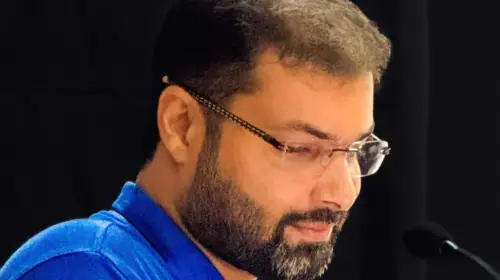
At BrilliantRead Media, we always strive to bring meaningful and powerful stories from India and around the world to empower and motivate our growing community. As part of this endeavour, we invited Dr Krishna Athal for an exclusive interview with us. Dr Krishna is a Serial Entrepreneur, Life & Executive Coach, Corporate Trainer and Leadership Consultant. Let’s learn more about his background, journey and his advice for our community!
Excerpts from our exclusive interview with Dr Krishna:
Dr Athal, could you talk us through your background and your journey so far?
My journey has been a blend of boardrooms and breathwork, strategy decks and silent retreats. I have built businesses, advised leadership teams, trained managers, coached founders, and stood in front of rooms that needed both direction and emotional maturity in the same sentence.
Geographically, my work has been shaped across Mauritius, India, and Singapore. Culturally, it has taught me that ambition looks similar everywhere, but insecurity wears different masks. In some places, it becomes micromanagement. In others, it becomes over-agreement. In others, it becomes a quiet habit of postponing hard conversations.
Academically, I have always loved structured thinking. My education across Edinburgh Business School, York Business School, King’s College London, and Oxford University sharpened my appreciation for systems, strategy, and the social psychology of power.
But the deeper learning came from life. From watching what stress does to good people. From witnessing how success can amplify unresolved wounds. From seeing how a leader can win the market and still lose themselves.
So the arc of my journey is simple: I moved from building outcomes to building people who can hold outcomes without breaking.
Apart from being a Life & Executive Coach, you are described as a serial entrepreneur. What does entrepreneurship mean to you beyond the glamour?
Entrepreneurship is not freedom. It is a responsibility with no ceiling.
People romanticise the word because it sounds like independence. But true entrepreneurship is dependent on reality. Reality, as in cash flow, team psychology, customer trust, execution discipline, and the personal maturity to stop lying to yourself.
If I had to define it plainly, entrepreneurship is the willingness to carry uncertainty without compromising your integrity.
It also forces you to meet yourself. Your impatience. Your need for control. Your relationship with risk. You need to be liked. If you are not careful, your business becomes a mirror you keep smashing.
How did you discover your passion and your life’s direction?
Through lived experiments, not motivational slogans.
Most people wait for clarity before action. I did the reverse. I acted, reflected, and refined. Over time, patterns emerge. Not the noisy patterns of what you enjoy on a good day, but the deeper patterns of what you return to even when it is hard.
I realised I am most alive at the intersection of three things: psychology, leadership, and behaviour-change. Strategy matters, yes. But strategy fails in the hands of a dysregulated leader. A beautiful plan is useless if the person executing it cannot manage their fear, ego, fatigue, and reactivity.
So my passion became less about “what industry” and more about “what human problem”. The human problem I keep returning to is this: people want growth, but they resist the inner work growth demands.
What is the most misunderstood thing about leadership?
That leadership is a personality.
Leadership is not charisma. It is capacity. The capacity to stay steady when pressure rises. To tell the truth without cruelty. To listen without collapsing. To decide without rushing. To hold power without becoming addicted to it.
A lot of people confuse confidence with competence. Confidence is a mood. Competence is a practice. Leadership is the practice of competence under stress.
Also, leadership is not just about how you lead others. It is how you lead yourself in private, when nobody is clapping.
You often speak about behavioural change. Why does change feel so hard for smart people?
Because intellect does not govern behaviour. Nervous systems do.
Smart people can describe their patterns beautifully. They can diagnose themselves with alarming accuracy. They can quote books. They can attend workshops. And yet, they repeat the same reactions in real life because the trigger arrives faster than their insight.
Most change fails for two reasons:
1) People try to change their behaviour without changing their identity.
2) People try to change their identity without addressing emotional pain.
Real change happens when you can hold discomfort long enough to choose a new response. That is not IQ. That is emotional regulation. That is self-leadership.
In tough times, what keeps you going?
A simple inner rule: do not betray your values just to reduce today’s discomfort.
When things get tough, the temptation is to become short-term. To chase quick wins. To compromise standards. To avoid difficult conversations. To let fear masquerade as “strategy”.
What keeps me going is remembering why I do the work. I care about building leaders who do not create emotional damage in the name of results. I care about cultures where people perform without losing their dignity. I care about teaching people that healing is not soft; it is a skill.
And on difficult days, I come back to the basics: breath, movement, silence, and honest reflection. The yogic part of me reminds the entrepreneurial part of me: you are not behind, you are just human.
What personal philosophies guide your decision-making?
Three principles:
First, clarity over comfort. If I avoid clarity, I pay with prolonged anxiety. Clarity can sting, but it heals faster than confusion.
Second, systems beat mood. I do not trust motivation. I trust routines. When you build a system, you do not need to feel inspired to do what matters.
Third, power must stay conscious. Power without awareness becomes control. Control becomes fear. Fear becomes toxicity. So I constantly watch my relationship with authority, ambition, and validation.
What are three life lessons that changed you?
Lesson one: Your life becomes your nervous system.
If you live in chronic stress, you will build a life that keeps producing it. Calm is not a luxury. It is a leadership requirement.
Lesson two: You cannot outwork unresolved emotion. Many high-performers are not ambitious; they are anxious. They call it drive. It is often fear wearing a suit.
Lesson three: A meaningful life requires clean boundaries.
Boundaries are not walls. They are doors with hinges. They allow closeness without self-abandonment.
You operate across Mauritius, India, and Singapore. How has that shaped you?
It has made me less attached to one definition of “normal”.
Each place has a different relationship with hierarchy, time, communication, and risk. When you work across cultures, you learn to separate essence from style. The essence is always human: people want respect, safety, growth, and meaning. The style changes: some cultures are direct, some are diplomatic, some are fast, some are relational-first.
This cross-cultural exposure also sharpened my belief that the future belongs to leaders who can blend performance with humanity. The old model of fear-driven leadership is collapsing. Quietly, but surely.
What is your approach when coaching leaders and founders?
Most people try to fix behaviour first. I help them see the engine underneath.
Because a leader’s calendar reveals their priorities, but their reactions reveal their wounds.
We work with reflective tools, structured frameworks, and practical experiments. I believe in depth, but I also believe in outcomes. Insight without action is entertainment.
Many people chase productivity. What do you think they are actually chasing?
Usually, worthiness.
People overwork because stillness feels unsafe. Silence forces you to feel what you have been avoiding. Productivity becomes a socially accepted escape.
Real productivity is not doing more. It is doing what matters without burning down your health and relationships. A high-achieving life without inner peace is a very expensive mistake.
What makes your journey satisfying and exciting today?
Watching people change in real time.
When a founder stops sabotaging relationships. When a manager learns to have a difficult conversation without aggression. When a high-performer learns to rest without guilt. When someone finally sees that confidence is not volume, it is inner steadiness.
That is exciting. Because it is real. It is not motivational content. It is a transformation.
I also find deep satisfaction in building ventures and initiatives that create social impact alongside business value. I want my work to improve lives, not only balance sheets.
What are you building next? What should readers look out for?
More work that integrates leadership development with psychological depth.
The world does not need more information. It needs better integration. We already know what is right. The question is: can we live with it when we are stressed?
You will see more from me around conscious leadership, ethical influence, behavioural change, and practical frameworks that leaders can actually use in the middle of messy, real workdays.
If someone Googles “Dr Krishna Athal” five years from now, what do you hope they find?
Not just content. Not just credentials. Not just achievements.
I hope they find a body of work that made leaders kinder and stronger at the same time. That helped people build businesses without losing themselves. That made emotional resilience a respected skill, not a private struggle.
And if they find anything else, I hope it is this message beneath it all: your life can change when you stop living unconsciously.
Finally, what is one line you would leave with young entrepreneurs and leaders?
Do not confuse intensity with progress.
Build your inner stability as if your business depended on it, because it does. And treat people well on the way up, not because it is good PR, but because it is good karma and even better leadership.
BrilliantRead is committed to bringing stories from the startup ecosystem, stories that reshape our perspective, add value to our community and be a constant source of motivation not just for our community but also for the whole ecosystem of entrepreneurs and aspiring individuals.
Note: If you have a similar story to share with our audience and would like to be featured on our online magazine, then please write to us at [email protected], we will review your story and extend an invitation to feature if it is worth publishing.