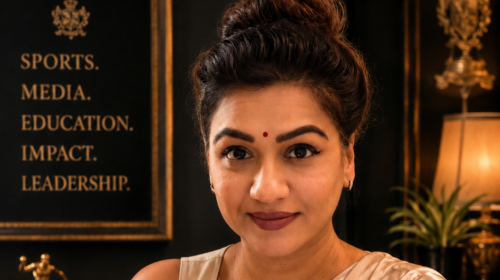
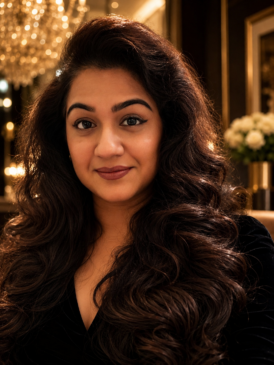
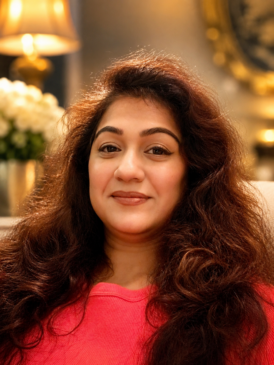
At BrilliantRead Media, we always strive to bring meaningful and inspiring stories from India and around the world to empower and motivate our growing community. As part of this endeavour, we invited Dr Kanthi D Suresh for an exclusive interview with us. Dr Kanthi is a Sports Education Leader, Founder at Sports Life Skills Framework and President at HIPSA. Let’s learn more about her inspiring journey, teaching philosophy, and valuable insights.
Excerpts from our exclusive interview with Dr Kanthi:
You have built an unusual career spanning sports media, entrepreneurship, sports development and now education. How did that journey eventually lead you to look at sport not simply as competition, but as a tool for human development?
My career has never really followed a conventional straight line, but sport has been the thread connecting almost everything I have done.
I began in sports broadcasting, working around major sporting events and eventually building Power Sportz. That gave me a ringside view of sport not merely as competition, but as a powerful human environment. You see athletes dealing with pressure, disappointment, uncertainty, teamwork, conflict, responsibility and success, sometimes within the space of a few minutes.
Later, when my work expanded into sporting platforms and HIPSA, I began looking at sport differently. I became increasingly interested in what happens to the person behind the performance.
We frequently say, “Sport builds character.” But I started asking a different question: If sport really builds character, where is the evidence of what has actually been built?
A child may play sport throughout school and leave with records of matches, medals and participation. But where is the record of the resilience developed after losing? The decisions made under pressure? The ability to collaborate with difficult personalities? The confidence to lead?
That question eventually took me from covering sport to creating sport, and from creating sport to studying what sport can teach.
The Sports Life Skills Framework grew out of that journey. I don’t see sport simply as an extracurricular activity. I see it as one of education’s most powerful experiential classrooms, provided we learn how to recognise and structure the learning already taking place there.
We often hear that “sport builds character.” You have questioned whether schools actually know what a child has learnt through sport. What gap did you identify, and how did that lead to the Sports Life Skills Framework?
The gap I saw was surprisingly simple: schools provide enormous opportunities for holistic development, but we measure very little of what those opportunities actually develop.
We measure mathematics. We measure science. In sport, we measure speed, scores, medals and performance. But what about decision-making? Resilience? Communication? Teamwork? Adaptability? Leadership?
These are qualities virtually every school says it develops, yet they often remain assumptions rather than visible learning outcomes.
That became the starting point for the Sports Life Skills Framework. Designed for Classes 6–12, it follows a progressive pathway of 7 levels, 42 modules and 168 micro life skills.
Instead of teaching life skills as abstract definitions, we use sporting situations because sport forces behaviour to reveal itself.
It is easy to say, “I am resilient.” It is much more meaningful to examine what you actually do after losing. It is easy to discuss decision-making. It is different when you have seconds to make a decision that affects an entire team.
Knowing what resilience means is knowledge. Responding resiliently when circumstances go against you is capability.
Our objective is to help schools bridge that gap through structured learning, reflection, behavioural assessment and evidence of progression.
I believe the next evolution of holistic education will be evidenced holistic education, moving from saying, “We develop the whole child,” to being able to demonstrate how that development is actually taking place.
The framework covers 7 levels, 42 modules and 168 micro life skills from Classes 6–12. How do you turn qualities such as resilience, decision-making, teamwork and leadership into structured learning without turning sport into another classroom subject?
That balance is fundamental. The moment we make sport feel like another textbook subject, we risk losing the very quality that makes it such a powerful learning environment.
The framework therefore starts with authentic sporting experience, not theory.
Students encounter situations involving choices, pressure, teamwork, success, setbacks and responsibility. The educational layer helps them recognise the skill being used, reflect on what happened, understand the consequences of their response and transfer that learning into other parts of life.
We are not trying to teach a child the definition of resilience while they sit beside a playing field. We want the child to experience a setback, understand their response and recognise how the same ability to recover can help them in an examination, a relationship or a future workplace.
That is why I often describe the shift as moving from playing sport to learning through sport.
The sport remains real. The learning becomes intentional.
Your framework is aligned with NEP 2020, NCF and competency-based education and also carries UK CPD accreditation. How does it translate these educational principles into practical experiences for students and teachers?
Policy becomes meaningful only when a child experiences it.
Terms such as competency-based learning, experiential education and holistic development are extremely important, but the real challenge is translating them into something that happens naturally in a student’s life. Sport gives us that opportunity.
Consider decision-making. Instead of giving a child a definition, sport creates situations where a decision has to be made. The student experiences the choice, its consequence and its impact on other people. That experience can then be reflected upon and transferred beyond sport.
The same principle applies to resilience, communication, collaboration, leadership and responsibility.
The Student Sports Life Skills Framework is accredited by The CPD Group, UK, while HIPSA’s Teacher Professional Development Programme is separately accredited by The CPD Certification Service, UK.
That distinction is important because meaningful implementation requires both sides: students need a structured learning pathway, while teachers need the capability to recognise and reinforce that learning.
Ultimately, accreditation gives external validation, but the real test is much simpler: Does the learning travel with the child beyond the playing field?
If it changes how a student responds at home, in school, in relationships or eventually at work, then sport has become education in the fullest sense.
You created the AUERTA-M Engine for structured behavioural learning and assessment. Can something as complex as resilience or leadership really be measured without labelling a child?
That question was one of the reasons AUERTA-M had to be created.
You cannot assess a life skill in exactly the same way you assess factual knowledge. If I ask a student, “Is resilience important?” almost every student knows the correct answer. That tells me very little about how they understand resilience in a real situation.
AUERTA-M follows the journey of behaviour rather than simply testing definitions. It takes the student through recognising a skill, understanding its usage, examining its effect and repercussions, transferring the learning beyond sport, articulating it, and finally demonstrating understanding through situational assessment.
The important idea is transfer.
If a child understands teamwork only while playing football, we have developed a sporting behaviour. If that child begins applying collaboration in a classroom project or at home, we have developed a life skill.
Assessment also has to be handled responsibly. The purpose should never be to stamp a child as “poor at resilience” or “a weak leader.” Children are developing.
Assessment should function as a mirror, not a label.
It should help schools, teachers and students see where development is occurring and where further experiences and reflection may help. That philosophy is central to AUERTA-M.
Artificial intelligence is rapidly becoming accessible to every student. You often ask, “When AI becomes the level playing field, what becomes the cutting edge?” What do you believe the answer is?
I believe part of the answer will be human capability.
For years, access to information and technology created an advantage. But imagine a world in which every student has access to extraordinarily capable AI. The differentiator may no longer be who can retrieve information fastest or generate the most polished answer.
The more important questions become: Can the student judge whether that answer is sensible? Can they communicate an idea persuasively? Can they work with people? Can they adapt when the obvious solution fails? Can they recover from disappointment? Can they make an ethical decision when technology gives them ten possible options?
These capabilities become more, not less, important in an AI-enabled world.
AI and human capability should not be positioned as competitors. Future-ready students will need both.
Technology can provide an answer; a human being still has to decide what to do with it.
So when AI becomes the level playing field, I believe judgement, resilience, adaptability, communication, collaboration and leadership will increasingly become the cutting edge.
You have spoken about moving from “holistic education” to “evidenced holistic education.” What does that mean, and do you believe schools will eventually be expected to demonstrate life-skills development just as they demonstrate academic progress?
Schools already do a great deal for holistic development. They provide sport, clubs, leadership roles, experiential learning, community engagement and many other opportunities.
The problem is not the absence of opportunity. The gap is the visibility of outcome.
A school can tell a parent that it develops leadership or resilience, but how does it demonstrate what changed in the child? That is what I mean by evidenced holistic education.
It does not mean reducing every human quality to a mark or percentage. In fact, that would defeat the purpose.
It means becoming more intentional about the competencies we want to develop, creating appropriate experiences, observing and assessing learning responsibly, and giving students meaningful evidence of progression.
Academic education has spent decades developing systems for showing progression. I think holistic education will increasingly be asked to answer the same basic question:
What did the student actually develop?
The future may therefore be less about adding more activities to the school calendar and more about understanding the developmental value of the activities schools already provide.
The Sports Life Skills journey is now extending beyond school into collegiate certification. Why is a school-to-college continuum important, and how can progressive, globally relevant certification help prepare Indian students for the future?
For me, this is the natural next step.
Life skills should not be treated as a one-time intervention that ends when a student leaves school. If we genuinely believe that resilience, judgement, communication, collaboration, leadership and ethical responsibility matter for life and work, their development should continue as the learner matures.
The school years create the foundation. College is where those competencies encounter greater independence, complexity, career choices and real-world responsibility.
A structured continuum allows the learner to move from foundational life skills in school to more applied, professional and future-ready competencies in higher education.
That thinking has now led us to extend the Sports Life Skills pathway into a collegiate certification programme, creating a progressive framework through which students can continue to build, reflect on and evidence their competencies beyond Class 12.
The collegiate pathway uses self-directed learning, sports-inspired scenarios and reflective practice, with certification providing visible evidence of progression.
This becomes particularly relevant at a time when academic achievement, while essential, is increasingly only one part of global readiness.
Employers and institutions are looking for evidence of what a young person can actually do: how they think, decide, adapt, collaborate and lead.
I believe the strongest model for India is therefore not school skills on one side and employability skills much later on the other. It is a continuous journey:
School → College → Career with progressively stronger evidence of human capability.
Global relevance then comes not from a certificate alone, but from the combination of academic knowledge, demonstrated competencies and credentials that can travel with the learner.
You are now identifying select leading educational groups across states as pioneering institutions for the Sports Life Skills Framework. Why have you chosen a selective approach rather than immediately taking the programme to as many schools and colleges as possible?
Because I believe credibility should come before scale.
With a new educational category, the first question should not be, “How quickly can we put this into thousands of schools?” It should be, “Can we demonstrate that it works meaningfully in strong school environments?”
Established school groups give us the opportunity to implement across multiple campuses, work with experienced educators, understand different student contexts and build credible models that can later be replicated.
We are therefore looking for institutions that already value holistic education and are ready for the next step, moving from providing life-skills opportunities to systematically developing and evidencing those skills.
I would rather build a smaller number of exemplary implementations that other schools genuinely want to learn from than achieve rapid numerical scale without depth.
Once the model is demonstrated strongly, scale becomes much more meaningful.
If we meet a student in 2035 who has gone through seven years of structured Sports Life Skills learning, what would you hope to see in that young person and what would success ultimately mean to you?
I would hope we see much more than someone who remembers the terminology of life skills.
I would want to see a young person who can make a difficult decision without being paralysed by uncertainty; who can lose without being defeated by the loss; who can work with people very different from themselves; who can communicate with confidence without losing the ability to listen; and who understands that leadership is as much about responsibility as authority.
Today, a student can finish school with records of academic marks, competitions, tournaments and medals.
I would like us also to be able to say:
Here is how her decision-making developed. Here is evidence of her resilience. Here is how she learnt to collaborate. Here is how her leadership evolved.
That changes the meaning of sports education.
Ultimately, I would like a certificate in life skills to represent much more than attendance at a programme. I want it to represent a journey of becoming.
And if, years later, that young person faces a difficult decision, recovers from failure, leads responsibly or works effectively with people very different from themselves, then the real value of the framework will not be on the certificate.
At BrilliantRead, we don’t just share startup stories; we bring you journeys that challenge perspectives, spark ideas, and fuel ambition. Every story we feature is carefully chosen to add real value, inspire action, and ignite possibility within our growing community of entrepreneurs and dreamers.
If you have a powerful story, one that can inspire, educate, or create impact, we want to hear from you.