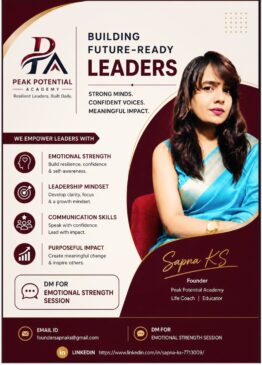
At BrilliantRead Media, we always strive to bring meaningful and powerful stories from India and around the world to empower and motivate our growing community. As part of this endeavour, we invited Sapna KS for an exclusive interview with us. Sapna KS is a Global Education & Leadership Expert, Keynote Speaker and Founder of Peak Potential Academy. Let’s learn more about her background, journey and her advice for our community!
Excerpts from our exclusive interview with Sapna KS:
After 15 years in corporate leadership, what was the defining moment that made you decide, “I need to transform education”?
For 15 years, I believed the traditional formula for success: good school, good marks, good college, good job. I lived that journey myself.
As a Director leading a team of over 300 professionals, I hired exceptional talent and built high-performing teams. Over time, I noticed something surprising: the people who truly excelled weren’t always the academic toppers. They were the ones who stayed calm under pressure, spoke up when the stakes were high, and bounced back after setbacks.
I vividly remember a gold medalist who froze after his first project failure and resigned within three months. On the other hand, I promoted someone from a Tier-2 college who transformed a crisis into one of our biggest successes because she had emotional resilience and persistence.
That made me realise something profound: schools, colleges, and workplaces operate in silos. Our education system prepares students to pass exams, but life demands much more.
I kept waiting for someone to bridge that gap. Then I realised that someone had to be me.
Peak Potential Academy was born from the belief that the future doesn’t just need intelligent minds, it needs emotionally strong individuals who can thrive in a high-pressure world.
You often say our education system was designed for the Industrial Era, not the Intelligence Era. What are the biggest gaps you believe still exist today?
I don’t believe schools are failing. In fact, they do an excellent job of building academic competence.
The challenge is that the world has evolved much faster than education itself.
Our education system was designed for an era where success depended on memorising information, following instructions, and fitting into standardised systems. Today, information is available instantly. Artificial Intelligence can retrieve facts in seconds.
What the world increasingly values are qualities like critical thinking, communication, adaptability, emotional resilience, and leadership.
One of the biggest gaps is emotional literacy. Very few students are taught how to deal with rejection, manage anxiety, recover from failure, resolve conflict, or rebuild confidence after setbacks.
These aren’t “soft skills.” They’re survival skills for the Intelligence Era. Long-term success isn’t built on intelligence alone; it’s built on emotional strength.
Many parents still believe academic excellence guarantees success. What would you say to them?
I think parents are asking the wrong question.
The question isn’t whether marks matter. Of course they do. Good grades open doors, create opportunities, and expand choices.
The more important question is: What happens after those doors open?
During my years of hiring and mentoring professionals, I consistently observed that the people who progressed the fastest weren’t necessarily the toppers. They were the individuals who handled pressure well, learned from failure, adapted quickly, and inspired others.
My concern isn’t that parents value academics. It’s when a child’s entire sense of self-worth becomes tied to marks and rankings. Then one poor result can feel like the end of the world.
We should raise children who strive for excellence while knowing their value is far greater than any exam score or college name.
Because life ultimately tests far more than what you know, it tests who you become when things don’t go your way.
With AI rapidly transforming the future of work, what should teenagers start learning today to stay relevant tomorrow?
I believe every teenager should strengthen three essential muscles.
First, Emotional Awareness, understanding what you’re feeling before those emotions begin controlling your decisions.
Second, Creative Adaptability involves thinking beyond existing solutions, asking better questions, and finding new ways to solve problems.
Third, Persuasive Communication is the ability to build trust, influence people, and communicate ideas effectively.
The future won’t reward people who compete with machines. It will reward those who know how to collaborate with technology while remaining uniquely human.
Be the mind that guides the machine, not the one replaced by it.
Teenagers today are dealing with unprecedented levels of anxiety, comparison, and pressure. How can parents and schools build emotionally resilient young leaders?
Today’s teenagers constantly seek validation through marks, rankings, followers, college admissions, careers, and relationships. When self-worth depends entirely on external outcomes, anxiety becomes inevitable.
I’ve seen parents break down because their child refused to eat before an exam, not because the child feared failing, but because they feared becoming “nobody.”
Resilience isn’t built by eliminating pressure. It’s built by strengthening a person’s inner foundation.
One exercise we use begins every class with a simple question: “What did you fail at this week, and what did you learn?”
Initially, students hesitate. But within a few months, they proudly share their biggest failures because they’ve learned to view setbacks as opportunities rather than scars.
I also encourage parents to ask one powerful question every evening: “What made you proud today that had nothing to do with winning?”
That conversation can transform how children define success.
Every teenager will experience rejection and disappointment. The real question is whether they’ve developed the emotional strength to remain standing when it happens.
What makes Peak Potential Academy different from traditional coaching or personality development programs?
Most personality development programs focus on improving outward performance.
At Peak Potential Academy, we focus on the person behind the performance.
Everything begins with emotional strength because confidence, leadership, communication, and resilience aren’t isolated skills; they’re outcomes of a stronger inner foundation.
We help students learn how to handle pressure, recover from setbacks, communicate effectively, think independently, and build a healthier relationship with themselves.
Parents shouldn’t expect simply a more confident child.
They should expect a more self-aware, emotionally resilient young adult who is prepared not just for exams, but for life itself.
If you could leave every parent and teenager with one message about preparing for the future, what would it be?
Stop preparing for a predictable future because it no longer exists.
For decades, success followed a straightforward path: study hard, earn good grades, get a degree, and build a career.
Today, technology is reshaping industries faster than education can adapt. Many careers that today’s students will pursue haven’t even been created yet.
In such a world, certainty is no longer the goal.
Adaptability is.
The people who thrive will be lifelong learners, individuals who can communicate, think critically, adapt to change, and remain emotionally strong regardless of circumstances.
The future won’t reward those who have all the answers.
It will reward those who continue learning when the answers keep changing.
That’s why emotional strength is no longer optional. It’s one of the most important life skills every young person needs to build.
At BrilliantRead, we don’t just share startup stories; we bring you journeys that challenge perspectives, spark ideas, and fuel ambition. Every story we feature is carefully chosen to add real value, inspire action, and ignite possibility within our growing community of entrepreneurs and dreamers.
If you have a powerful story, one that can inspire, educate, or create impact, we want to hear from you.