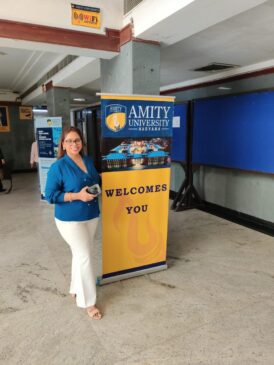
At BrilliantRead Media, it is our constant endeavour to identify and bring to light some of the inspiring, unique, and compelling stories from the startup ecosystem. As part of this initiative, we are delighted to feature Anuradha Parakala, Entrepreneur, Speaker, Co-founder and COO of Fleetronix Systems Pvt. Ltd., in an exclusive interaction with BrilliantRead Media.
With over 15 years of experience in driving innovation, business growth, and transformation, Anuradha has been at the forefront of leveraging technology to solve complex industry challenges. At Fleetronix, she is contributing to the evolution of the logistics sector through AI-powered operating systems that bridge the gap between enterprise systems and real-world operations. Beyond technology and business leadership, she is also passionate about creating meaningful opportunities for women returning to the workforce.
Through this conversation, we explore her entrepreneurial journey, leadership philosophy, the transformative potential of AI in logistics, and her vision for building technology-driven, people-centric organisations.
Let’s learn more about her background, inspiring journey, experiences, and valuable advice for our growing community!
Excerpts from our exclusive interview with Anuradha;
You have spent over 15 years driving innovation, growth, and transformation. What is one leadership lesson you learned the hard way that fundamentally changed how you lead today?
One of the most important leadership lessons I have learned is that speed without clarity can create more problems than progress.
Over the years, I have realised that leadership is not about having all the answers or controlling every outcome. It is about understanding the problem deeply, listening to the people closest to it, and making decisions with conviction.
I have also learned not to confuse activity with impact. A team can be extremely busy without necessarily moving in the right direction. Today, I focus more on outcomes, accountability, and building an environment where people feel empowered to take ownership.
The biggest shift in my leadership approach has been moving from trying to solve everything myself to building systems and teams that can solve problems independently.
At Fleetronix, you are building AI-powered operating systems for the logistics industry. What is the biggest problem in the industry that AI can genuinely solve, and what should we never expect AI to replace?
I will start with a confession: for a long time, everyone was made to believe that logistics was a tracking problem. It isn’t.
Consider a steel plant, cement plant, or power plant. High-value raw materials arrive, and finished goods move out. Every dispatch begins in SAP, which records what was supposed to move, how much, to whom, and by when. Once the truck leaves, its GPS tells us where it actually is.
Both systems are accurate, but they rarely communicate with each other.
SAP knows what should have happened. GPS knows what actually happened. The truth lies in the gap between the two, and in most plants, nobody is systematically looking at that gap.
That is the problem Fleetronix is addressing. We have built an operating layer that connects enterprise systems with vehicles and gives plants three critical insights: what is happening, why it is happening, and what needs to be done about it.
The impact is tangible. Transporter accountability is now supported by evidence rather than arguments. Waiting-charge claims can be settled using actual data. Potential delays can be identified before they become operational disruptions. Unauthorised stops and route diversions can be detected in real time, while driver and vehicle profiles help identify reliability patterns.
However, I don’t believe AI should replace human judgment. It should eliminate repetitive monitoring, improve visibility, and help people make better decisions. Technology can identify an anomaly, but understanding its operational significance still requires human experience.
You believe AI should remove friction from decision-making rather than replace people. What does an AI-native organisation look like in practice?
Forget the organisation chart for a moment. Think about what happens at 2 a.m. when a truck carrying high-value imported pet coke deviates from its approved route.
In a traditional setup, nobody might notice until the material arrives short at its destination.
In our approach, the system identifies the route deviation immediately. Our team receives an alert and contacts the driver with specific information rather than relying on a vague suspicion. The alert is updated with the driver’s explanation and the action taken, whether it is a puncture, a wrong turn, or something that requires escalation.
At the unloading point, the system can also compare loading and unloading photographs to identify mismatches in quantity or condition.
The machine does the monitoring, comparison, and alerting. People do the communicating, investigating, and decision-making.
That is what being AI-native means to me. It is not about having fewer people. It is about enabling people to spend their time making meaningful decisions rather than searching for information.
As a Co-founder, COO, and CPO, you operate across product, strategy, growth, and execution. How do you balance the need to move fast with the discipline required to scale sustainably?
My honest answer is that I don’t balance them; I sequence them.
At our stage, I remain deeply involved in product, operations, and strategy. However, I follow a clear order of priorities.
First comes the customer. We need to understand what the plant actually needs, not what looks technologically impressive. The real question is whether customers will find it useful and whether it solves a problem they are willing to pay for.
Growth comes next. If customers are pulling for a solution, that tells us something meaningful about its value. A feature nobody asks for isn’t necessarily product strategy; sometimes, it is simply a distraction.
Discipline comes third, particularly when something starts breaking repeatedly. I don’t believe in creating processes for problems that don’t exist yet. But the moment a mistake repeats, it needs a rule, an owner, and a mechanism for accountability.
Moving fast inevitably creates some mess. Things break, and certain decisions need to be revisited. I accept that because the alternative is spending too much time perfecting something customers may never want.
My guiding principle is simple: speed helps us learn, while discipline ensures we don’t have to pay for the same lesson twice.
You believe the next decade belongs to companies combining deep industry expertise with AI-native execution. What will distinguish the companies that win from those that simply adopt AI as a buzzword?
I think we need to start by distinguishing between automation and AI. Somewhere along the way, basic automation started being renamed AI, and I believe that creates unnecessary confusion.
At Fleetronix, we use both, but we are careful about understanding the difference.
A scheduled report or a rule that automatically triggers an email is automation. It is useful, but it isn’t AI.
AI begins where fixed rules are no longer sufficient. For example, reading an unstructured weighbridge slip or driver’s licence requires OCR and intelligent data processing. Comparing loading and unloading photographs to identify possible theft or leakage, matching a driver’s face with the photograph on their licence, or analysing video footage involves AI capabilities.
Customer communication offers another example. Handling incoming messages through WhatsApp is automation. Understanding those messages, interpreting their intent, and responding appropriately in the customer’s language is where AI adds value.
My real test is scalability. If your customers double and your team also needs to double just to maintain the same level of service, your technology may not be delivering enough value.
There is another important dimension: industry knowledge. AI might identify a mismatch between two photographs, but understanding whether that mismatch is operationally significant at a steel or cement plant requires domain expertise.
Ultimately, the winners will not be the companies that talk about AI the loudest. They will be the ones that clearly understand where automation ends, where AI begins, and what measurable value they deliver to customers.
You are passionate about helping women return to the workforce. What is the biggest misconception organisations still have about women coming back after a career break, and what needs to change?
We have been discussing this issue for more than a decade. We have had panels, campaigns, hashtags, and Women’s Day conversations. Yet, a résumé showing a five-year career break often ends up in the same rejection pile.
The problem isn’t a lack of awareness. We have turned it into a conversation without translating it into meaningful changes in the hiring process.
The biggest misconception is that a career break represents an absence of work. In reality, it often represents a change in the nature and environment of work.
Organisations need to rethink how they evaluate returning professionals. I would start with three changes.
First, remove the career break as an automatic screening barrier. Second, assess candidates on what they can contribute today by giving them real problems to solve. Third, compensate them according to the responsibilities and value of the role, rather than making assumptions based on the duration of their career gap.
At Fleetronix, our Support, HR, and Accounts teams are led by women who have successfully returned to professional roles after career breaks. They are not simply part of a diversity initiative; they are leading critical business functions.
The talent is already there. What is needed is an opportunity for that talent to be recognised.
We have spent a decade talking about the issue. The next decade should be about changing hiring practices and creating meaningful opportunities.
Looking ahead five years, what is the bigger impact you want to create, not just through Fleetronix, but in AI, logistics, and the future of leadership?
Over the next five years, I want Fleetronix to become an integral part of how high-value coal moves across India, particularly for steel and power plants.
When it comes to AI, I want to demonstrate that technology doesn’t have to be flashy to create extraordinary value. Some of its most meaningful applications will be in heavy industries, where it quietly prevents losses, reduces delays, improves accountability, and eliminates operational surprises.
These improvements may not always make headlines, but they can fundamentally transform how industries operate.
On leadership, I strongly believe that empathy will define the future. The leaders who create lasting impact will be those who listen carefully, understand people, and then have the courage to act decisively.
At the end of the day, meaningful transformation does not always begin with grand ideas. Sometimes, it starts with solving small, real-world problems consistently. That is how we intend to build something much bigger.
At BrilliantRead, we don’t just share startup stories; we bring you journeys that challenge perspectives, spark ideas, and fuel ambition. Every story we feature is carefully chosen to add real value, inspire action, and ignite possibility within our growing community of entrepreneurs and dreamers.
If you have a powerful story, one that can inspire, educate, or create impact, we want to hear from you.