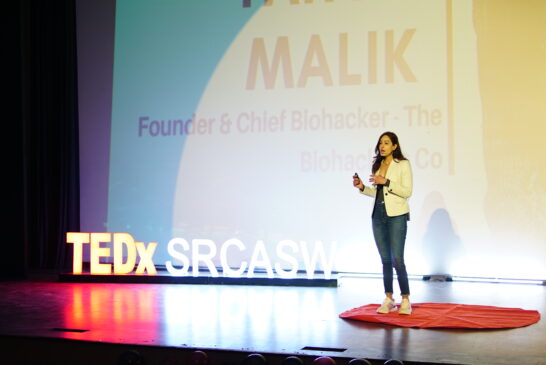
At Brilliant Read Media, it is our constant endeavour to identify and share some of the unique and compelling stories from the startup ecosystem. As part of this, we invited Tanya Malik Chawla for an interview with Brilliant Read Media. To say further, Tanya is a Biohacking Coach, Certified Functional & Clinical Nutritionist and TEDx Speaker. Let’s learn more about her background, inspiring journey so far and her advice for our growing community!
Excerpts from our exclusive interview with Tanya:
Your work focuses on optimizing biology rather than just managing symptoms—what triggered your shift toward functional medicine and biohacking?
I didn’t consciously choose functional medicine—it was something I was driven toward after hitting a wall with my own health.
On paper, I was doing everything “right”: eating clean, exercising regularly, and following conventional medical advice. Yet my body wasn’t responding the way it should.
I was dealing with PCOS, hypothyroidism, and metabolic dysfunction, and the only solutions I was offered revolved around long-term medication and managing symptoms rather than truly resolving them. That approach didn’t sit right with me.
What I began to realize is that conventional healthcare often focuses on diagnosing and labeling conditions, then managing them—but rarely digging deeper into why those conditions exist in the first place.
Functional medicine offered me that missing perspective. It looks at the body as an interconnected system rather than isolated symptoms. Biohacking, in turn, made that understanding practical and actionable.
It shifted the questions I was asking:
Why is insulin elevated?
Why is inflammation persistent?
Why are hormones out of balance?
That transition—from simply accepting a diagnosis to actively understanding underlying dysfunction—completely changed my approach to health and ultimately led me to this path.
You’ve personally reversed conditions like PCOS and hypothyroidism—how did that transformation shape your philosophy as a coach?
It clarified one fundamental truth for me:
Your body is not broken—your inputs are.
Reversing my conditions didn’t come from a single supplement or diet. It came from systematically correcting inputs:
Optimizing protein intake
Building muscle
Regulating insulin
Supporting micronutrient pathways
Improving sleep and stress physiology
That’s when my core philosophy took shape:
Biology responds to inputs. Change the inputs, and you change the outcome.
As a coach, I don’t treat diagnoses—I reverse dysfunctions. And more importantly, I don’t just give people hope—I give them mechanisms.
Biohacking is often seen as extreme or experimental—how do you define it in a way that is practical and sustainable for everyday people?
Most people associate biohacking with ice baths, red light therapy, or peptides.
That’s not biohacking—that’s optimization after you’ve built a foundation.
For me, biohacking is simple:
It’s the conscious control of your biology through data, habits, and environment.
That includes:
Eating enough protein to support muscle protein synthesis
Strength training to enhance mitochondrial function
Sleeping in alignment with your circadian rhythm
Stabilizing blood sugar
The advanced tools are optional.
The fundamentals are non-negotiable.
You emphasize data—biomarkers, genetics, gut health—how important is personalized data in designing effective health protocols?
Data is everything—because symptoms can mislead, but biology doesn’t.
Two people can experience the same symptom, like fatigue, and yet have completely different root causes:
> Iron deficiency
> Insulin resistance
> Gut dysbiosis
> Adrenal dysregulation
Treat them the same way—and you fail all of them.
This is where real precision begins.
Biomarkers, genetics, and microbiome data shift us from guesswork to clarity.
From generic protocols to individualized strategy.
It’s the difference between:
“Try this and see…”
vs
“This is exactly what your body needs right now.”
As a nutrigenomics researcher, how do you simplify complex genetic insights into actionable lifestyle changes for your clients?
Genetics can feel overwhelming, but I don’t present it as science—I translate it into decision-making clarity.
For example:
If someone has an MTHFR polymorphism → we optimize methylation with targeted B vitamins
If detox pathways like CYP450 are sluggish → we support phase 2 detox and reduce toxic load
If COMT is slow → we adjust caffeine intake, stress exposure, and neurotransmitter support
Instead of saying, “You have this SNP,” I explain:
“This is how your body processes nutrients differently—and here’s how we adapt your lifestyle accordingly.”
It becomes practical, not theoretical.
Many high performers still struggle with fatigue, gut issues, or hormonal imbalance—what are the most common root causes you uncover?
High performers are often the most metabolically stressed individuals I work with.
On the surface, they look disciplined, driven, and in control. But underneath, their biology is quietly struggling to keep up with the demands they place on it.
The most common root causes I see:
Micronutrient depletion — especially magnesium, B vitamins, and zinc, which are critical for energy production and stress resilience
Chronic nervous system overload — a constant state of sympathetic activation, where the body never truly switches off
Low protein intake & inadequate muscle mass — limiting recovery, metabolic health, and hormonal balance
Hidden insulin resistance — even in individuals who appear “fit” on the outside
Gut dysfunction— including SIBO, dysbiosis, and poor nutrient absorption
They’re doing more—but absorbing less.
Pushing harder—but recovering slower.
And that’s the problem.
Because high performance without biological support isn’t sustainable— it’s burnout in slow motion.
True performance isn’t just about output. It’s about whether your biology can sustain the life you’re building.
There’s a lot of noise in the wellness industry—how can people differentiate between real science-backed biohacking and trends or gimmicks?
A simple rule:
If it ignores biology, it’s a gimmick.
Real, science-backed biohacking:
Focuses on mechanisms—insulin, mitochondria, inflammation
Is measurable—biomarkers improve
Is repeatable across individuals
Gimmicks:
Overpromise rapid results
Ignore fundamentals like nutrition and sleep
Sell tools before teaching physiology
If something sounds trendy but doesn’t mention muscle, metabolism, or mitochondria—it’s likely marketing, not science.
You talk about “reversing biological age”—what does that actually mean, and how realistic is it for the average person?
Biological age is not your calendar age—it reflects how your body is actually functioning.
It’s influenced by:
Inflammation
Metabolic health
Cellular efficiency
Mitochondrial performance
When we talk about reversing biological age, we mean improving these markers so the body functions like a younger system.
This is measurable through:
Blood biomarkers
Epigenetic testing
Performance metrics like VO₂ max, strength, and HRV
And yes—it’s absolutely realistic.
I’ve done it. My clients have done it.
But it’s not magic—it’s the result of consistent, correct inputs over time.
Why does conventional healthcare often miss root causes, and how does functional medicine address this gap differently?
Because conventional healthcare is designed for acute care—not chronic disease.
It works exceptionally well for:
Infections
Emergencies
Surgical interventions
But chronic conditions require a different approach.
Conventional care focuses on:
Diagnosis
Prescription
Management
Functional medicine asks deeper questions:
Why is insulin elevated?
Why is inflammation persistent?
Why are hormones dysregulated?
It connects systems rather than isolating them.
That’s where the real shift happens.
If someone wants to start their biohacking journey today, what are the 3 foundational habits they should focus on first?
No gadgets. No supplements. Just fundamentals:
1. Sleep (7.5–9 hours, non-negotiable)
This is where recovery, hormonal balance, and repair happen.
2. Protein-first nutrition (~2g per kg ideal body weight)
You cannot fix metabolism without adequate amino acids.
3. Strength training (minimum 3x per week)
Muscle is your longevity organ.
If you get these three right, everything else becomes optimization.
BrilliantRead is committed to bringing stories from the startup ecosystem, stories that reshape our perspective, add value to our community and be a constant source of motivation not just for our community but also for the whole ecosystem of entrepreneurs and aspiring individuals.
Note: If you have a similar story to share with our audience and would like to be featured on our online magazine, then please write to us at [email protected], we will review your story and extend an invitation to feature if it is worth publishing.